


Olive oil conditioner vs regular conditioner: what is the difference?
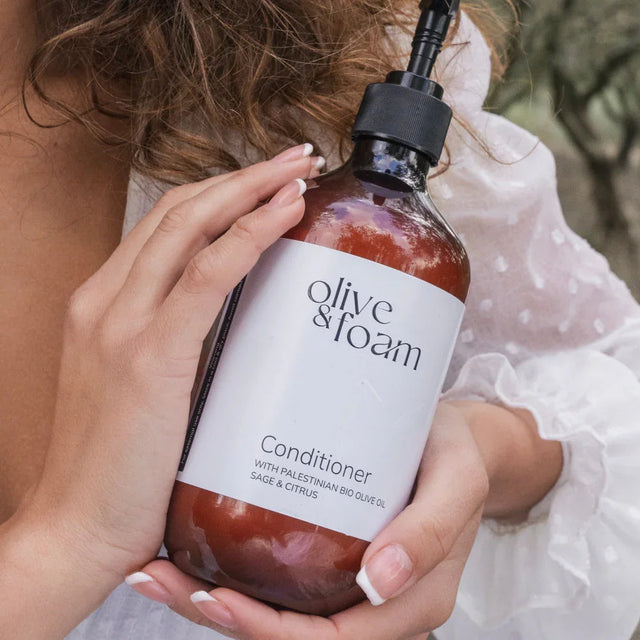
The conditioner aisle is full of products making similar promises: smooth, soft, frizz-free hair. Most of them work to some degree. But there are real differences in how they are formulated, and those differences affect how your hair feels and behaves over time.
Here is a straightforward comparison between a standard drugstore conditioner and an olive oil conditioner like ours — looking at what is actually in each, and what that means for your hair.
How conditioner works
Conditioner works primarily through a process called adsorption: positively charged conditioning ingredients deposit onto the negatively charged surface of the hair shaft, smoothing the cuticle and reducing friction between strands. This is what makes hair feel softer, easier to comb, and less prone to frizz after washing.
The quality of a conditioner depends on which conditioning agents it uses and how well they are formulated together.
What is in a typical drugstore conditioner
Most standard conditioners use a base of water, cetyl or cetearyl alcohol (fatty alcohols that provide slip and smoothness), a quaternary ammonium compound like Cetrimonium Chloride or Behentrimonium Chloride for conditioning, and silicones (usually Dimethicone) to add shine and reduce frizz on the surface.
Silicones work well in the short term but can build up on the hair over time, making it feel heavy and requiring clarifying shampoos to remove. They also coat the hair rather than conditioning it from within.
What is in the Olive & Foam Conditioner
Our Conditioner is formulated without silicones. Instead, it uses:
- Cetrimonium Chloride — a detangling agent that reduces friction and helps comb through wet hair
- Cetostearyl Alcohol & Cetyl Alcohol — fatty alcohols that provide slip and smoothness without coating the hair in silicone
- Glycerin — a humectant that draws moisture into the hair shaft and helps retain it
- Polyquaternium-7 — a conditioning polymer that deposits on the hair during washing for smooth, manageable results
- Olea Europaea Fruit Oil — Palestinian olive oil, which contributes conditioning and helps the formula integrate with the hair surface
The practical difference
Hair conditioned with fatty alcohols, glycerin, and olive oil — rather than silicones — tends to feel lighter and more natural after drying. There is no build-up over time, and hair retains its softness with regular use rather than requiring occasional clarifying to reset.
For people who find their hair feeling heavy or weighed down by their current conditioner, switching to a silicone-free formula is often the fix.
How to use it
Apply to wet hair after shampooing, focusing on mid-lengths to ends. Leave for 2–3 minutes, then rinse thoroughly. Use with the Olive & Foam Shampoo for best results — both are available together in the Shower Set.


0 تعليقات
لا توجد تعليقات على هذا المقال. كن أول من يترك رسالة!